


By Canvas & Ivy
Is wallpaper a good choice for a humid bathroom?
Wallpaper can work on a dry bathroom wall away from splashes when ventilation controls moisture and the exact product’s manufacturer permits the application. Postpone decorating while the room has persistent condensation, wet walls or unresolved dampness. Start with those conditions—not a blanket recommendation to buy vinyl.
Separate the decision into three checks:
- Room: Is moisture controlled during normal household use?
- Wall: Is the proposed surface outside direct spray and routine splashing?
- Product: Do the exact wallpaper’s instructions permit this application and wall surface?
If all three checks pass, consider proceeding. If only the location fails, choose another wall. If moisture control or product suitability remains uncertain, postpone the purchase. Do not rely on a bathroom category label or styled photograph alone.
Graham & Brown’s bathroom wallpaper guidance recommends keeping wallpaper away from direct water and preparing clean, dry, sound walls. Treat this as general manufacturer guidance, not approval for a particular Canvas & Ivy product.
Check the room before choosing a pattern
Assess the bathroom as your household actually uses it. A guest bathroom before visitors arrive may look different after several morning showers. One dry-looking moment is not enough information for the decorating decision.
Look for walls that remain visibly wet, persistent condensation, unresolved leaks and recurring dampness. Consider whether the available ventilation is used during ordinary showering—not simply whether the room has a fan or window.
The EPA recommends indoor relative humidity below 60%, ideally between 30% and 50%, and using a bathroom fan or opening a window when showering. It also identifies a humidity meter as a way to assess moisture levels.
These are general indoor moisture recommendations, not wallpaper approval thresholds. Do not use them to set a universal fan runtime or a deadline by which wallpapered walls must dry. Check the wallpaper manufacturer’s requirements separately.
Record actual conditions rather than writing “has ventilation.” For example, “walls remain wet after the household’s morning showers” identifies an unresolved issue. “Dry during a quiet afternoon” leaves the busiest part of the day unanswered. Observe the room across its usual routine before deciding.
If condensation persists, address moisture control first. Do not treat a small feature wall as a workaround for a room-wide moisture problem.
Check the wall: humidity and splashing are different exposures
Once room conditions support considering wallpaper, assess each proposed surface separately. Airborne moisture and water landing directly on a wall are different exposures; do not interpret permission for bathroom use as permission for both.
Sketch the room and mark the shower enclosure, tub surround, basin taps and surfaces that receive routine splashes. Graham & Brown advises keeping wallpaper out of shower areas, bath surrounds and splash zones behind basin taps. Follow the selected product’s restrictions as well.
Think about everyday use rather than fixture position alone. Does face washing splash a side wall? Does water reach the wall beside the shower entrance? Exclude those surfaces from your wallpaper plan rather than judging them only by their position outside the enclosure.
Wallpaper above an existing backsplash is a conditional option: the wallpapered portion must remain outside actual splash exposure, and the product must permit the application. Do not choose a backsplash height solely to accommodate wallpaper; map the splashes first.
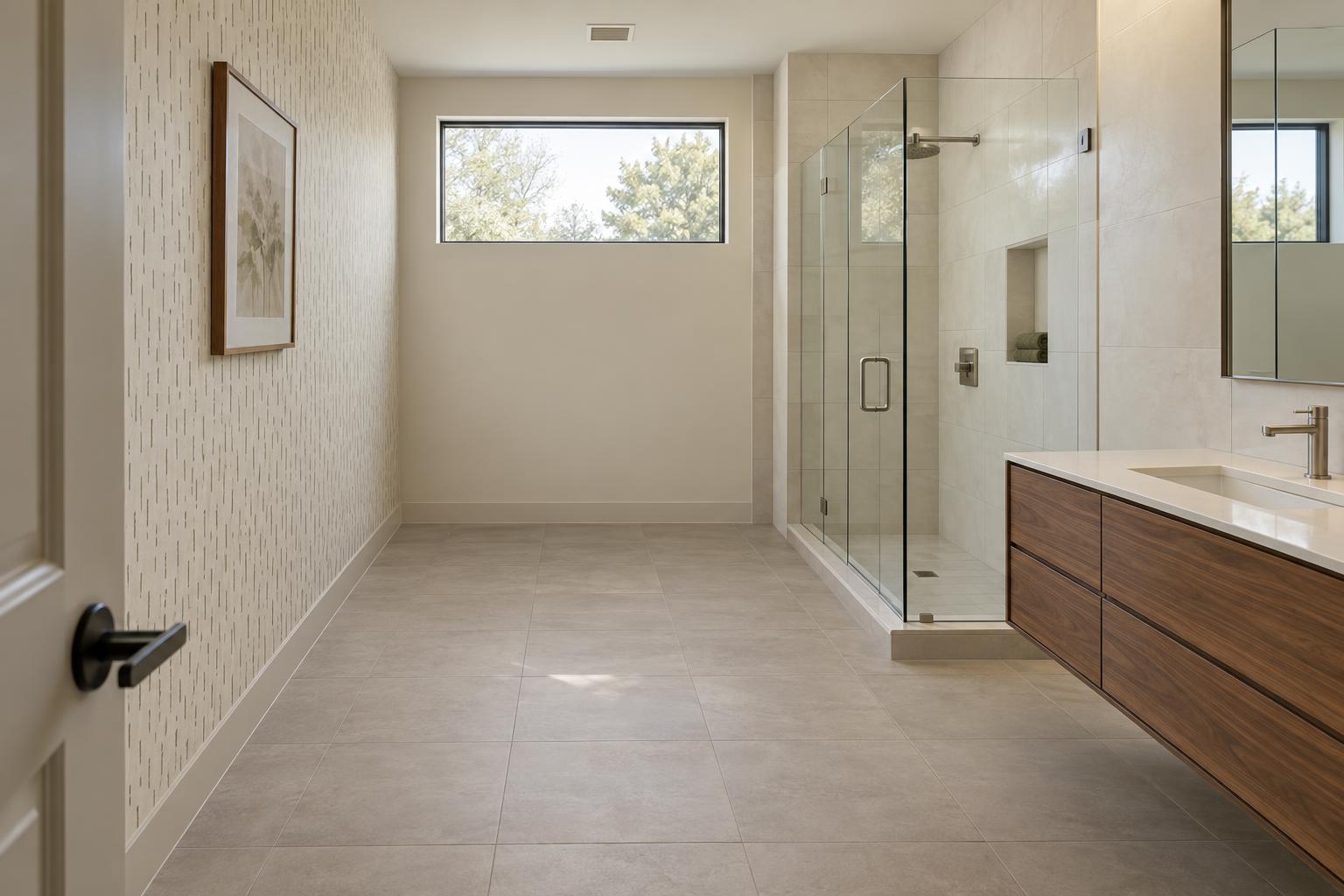
A patterned wall opposite the vanity may offer a better layout. You lose some wraparound pattern but gain a deliberate focal point, potentially visible in the mirror. That is a design tradeoff, not a performance guarantee.
Compare materials without mistaking resistance for approval
Material construction and installation format are separate questions. When a listing says “peel-and-stick,” also look for the face material, permitted exposures and preparation requirements. Start with our wallpaper type comparison, then check the exact option you intend to order.
Vinyl-coated and solid-vinyl wallpaper
Graham & Brown recommends moisture-resistant options, including vinyl-coated and solid-vinyl wallpaper, in its bathroom guidance. These categories are worth investigating, but do not approve a product on the material name alone.
The recommendation still comes with placement and preparation limits. Check exposure restrictions and compatibility with your existing wall finish. Do not assume that a vinyl description means waterproofing or permission for direct spray.
Plain paper, textile looks and specialty finishes
Do not approve or reject an unfamiliar construction based on appearance alone. A woven-looking print may be an illustration rather than a woven material. A matte photograph does not supply a technical specification.
For any paper, textile or specialty finish, ask what the product is made of and whether its instructions address your intended use. If that information is unavailable, keep it on a design shortlist rather than an installation schedule.
Peel-and-stick versus pasted wallpaper
Compare permitted surfaces, preparation, exposure restrictions and care rather than assuming either adhesive format is better for bathrooms. Check the requirements for the exact construction, even when the same pattern is available in several formats.
For a product marketed as removable, check bathroom-use instructions separately from removal instructions. Do not assume damage-free removal. Review the permitted wall finishes, removal method and stated limitations before buying.
Surface resistance is not the whole wall story
The Wallcoverings Association identifies excessive moisture as the underlying issue in mold associated with wallcoverings. Address the moisture source rather than treating a moisture-resistant face as a repair for a damp wall.
What to confirm in the exact product’s instructions
Read the instructions for the wallpaper and material option you intend to purchase. Do not substitute guidance for another construction from the same company. Look for documented conditions and exclusions, not just a bathroom marketing category.
- Intended use: Does this exact product permit bathroom installation?
- Exposure: What restrictions apply to humidity, condensation, splashing and direct water?
- Surface: Which substrates, paint finishes and existing coverings are permitted or excluded?
- Preparation: What wall preparation is required before installation?
- Installation: Which primers and adhesives are required or prohibited?
- Care and removal: Which methods are allowed, and what limitations are stated?
Confirm both room suitability and surface compatibility. If the instructions permit your wall finish but exclude the intended bathroom conditions, choose another location or product.
For questions about a Canvas & Ivy selection, start with the help center. Describe the room’s use, proposed wall, splash exposure and existing finish. “Daily-use shower bathroom, wall opposite the enclosure, no routine splashes, painted drywall” is more useful than “small bathroom.” Include paint details when known.
For a designer’s specification, record the chosen construction, location and preparation requirements. Give the installer and homeowner a specific plan rather than the shorthand “bathroom wallpaper.”
Prepare a dry, sound wall—not a cover-up for dampness
Graham & Brown calls for clean, dry, sound, smooth walls. Keep cosmetic preparation separate from moisture investigation: before smoothing or decorating a previously damp surface, establish why it became damp and whether the cause has been addressed.
An unexplained stain or history of water damage should prompt questions before pattern selection. A dense print might conceal discoloration visually, but do not use concealment as a reason to proceed.
The EPA identifies the back of wallpaper as a possible location for hidden mold. Investigate unresolved moisture rather than covering it, and seek appropriate help where the cause or extent is unclear.
Once the underlying issue has been addressed, return to the selected product’s preparation requirements. Consult our installation guidance alongside the instructions for your exact material. Do not improvise with extra adhesive or a coating to compensate for an unsuitable wall.
For renters, permission and suitability are separate
Follow the permission process required by your rental agreement, then check the wall finish, product requirements and removal limitations. Treat property permission and installation compatibility as separate checks; confirm both before committing.
Imagine finding a removable pattern that coordinates beautifully with existing tile. Its bathroom guidance is unclear, and you do not know whether the paint meets its surface requirements. Clarify those points before buying rather than assuming removability resolves them.
Include preparation in the permission discussion. Ask about any required primer or change to the wall finish, not just the finished wallpaper. If bathroom use cannot be confirmed, consider the pattern for another approved room where its requirements can be met.
Three bathroom scenarios: proceed, narrow the plan or postpone
Use these hypothetical examples to work through your own layout.
1. A dry powder room: consider proceeding
The room has no shower, its walls are dry, and the proposed wallpaper sits opposite the vanity, away from basin splashes. This is a reasonable location to investigate.
Check product approval and surface compatibility next. If confirmed, a patterned wall reflected in the mirror could make an appealing focal point. Keep the adjacent wall quieter if you want the reflection to frame the pattern rather than create an all-over effect.
2. A regularly used shower bathroom: narrow the plan
Moisture is controlled, but the original scheme wraps pattern around the vanity and toward the shower entrance. Some surfaces receive splashes. Revise the layout rather than automatically rejecting the whole idea.
Consider a dry wall opposite the fixtures, subject to product approval. For visual continuity, choose a wallpaper background that relates to the existing tile, then repeat one accent color in a towel or cabinet handle. Less coverage can still look intentional without extending wallpaper into unsuitable areas.
3. A shared bathroom with persistent condensation: postpone
Several people shower each morning, walls remain wet, and condensation persists. Postpone wallpaper rather than searching for a more resistant material. Address moisture control, then reassess under normal household use. Keep pattern samples for palette planning, but wait to place the wallpaper order.
Two pattern directions once suitability is confirmed
Choose these designs for color, motif and coordination only after confirming the selected material’s suitability for your bathroom. Do not use their catalog styling or room mockups as approval for humid conditions.
Northlake Loon Modern: graphic contrast for pale wood and stone
Northlake Loon Modern Wallpaper combines black-and-white birds with large geometric circles in muted blue-gray and warm sand. Its catalog description pairs the design with pale wood, matte black fixtures and cool-toned stone.
Consider it for an approved dry focal wall when those finishes already anchor the room. The circles offer a bolder alternative to small botanical sprigs. The tradeoff is visual activity: keep nearby accessories restrained if you want the birds and geometry to remain the main feature.
Cerise: a contained pop of color with retro character
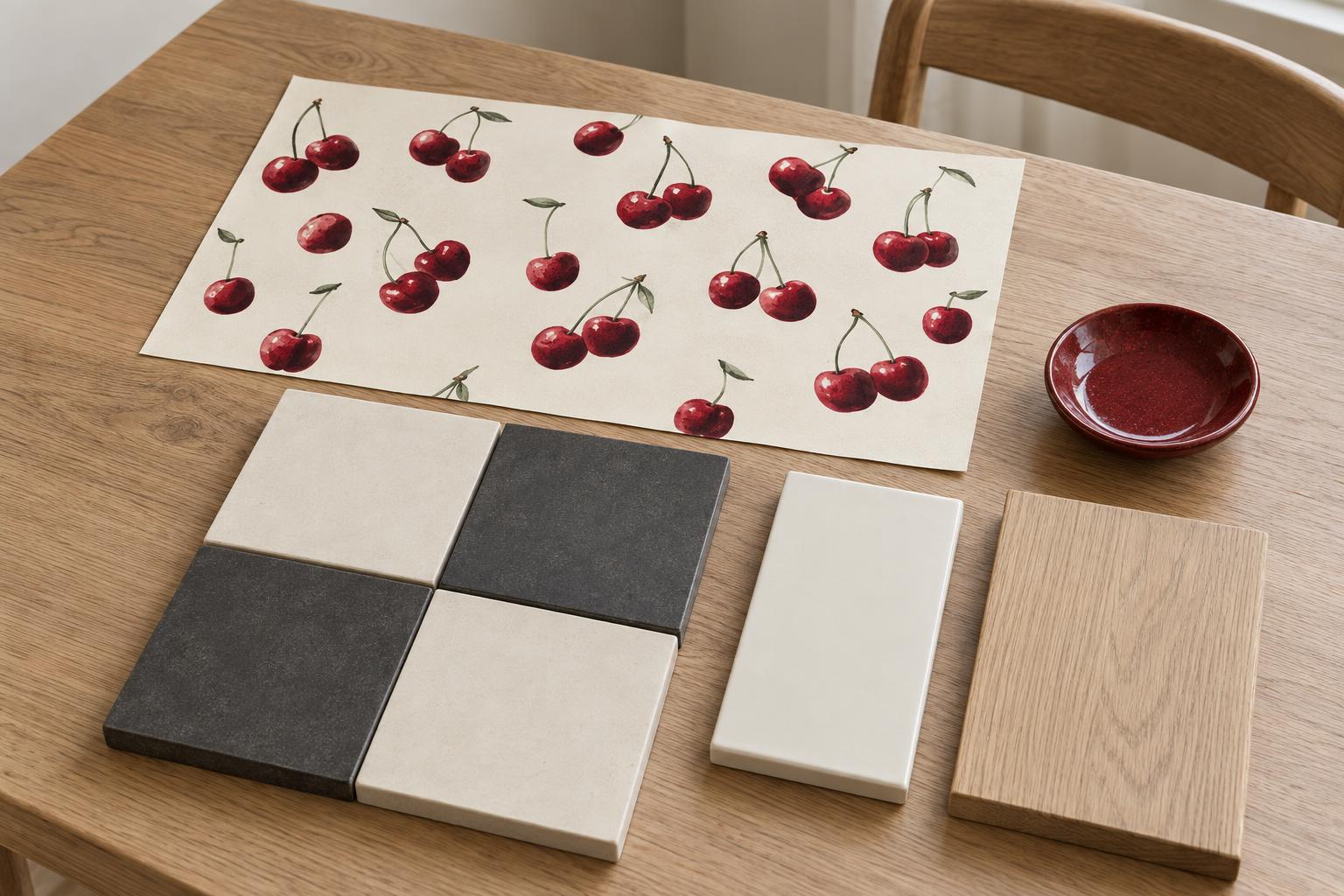
Cerise Wallpaper features loosely scattered crimson cherries on a neutral background, with watercolor rendering and stem-and-leaf detail. Its description suggests pairing it with checkered floors, ceramic tile or glass shelving.
For an approved dry wall, it offers a way to introduce red without changing cabinetry. Repeat the cherry color in one small accessory rather than every towel and fitting. If the floor is already patterned, compare the two together before committing. For a different palette, explore our coastal powder-room wallpaper ideas after settling the placement and material questions.


Practical questions before you commit
Does a bathroom fan make wallpaper suitable?
Do not decide on the fan’s presence alone. Observe moisture conditions during normal use, and check wall location and product requirements separately. Follow up on persistent condensation before decorating.
Is washable wallpaper waterproof?
Do not treat a cleaning description as waterproofing approval. Check the stated cleaning method and exposure restrictions separately, especially where water routinely lands on the proposed wall.
Can I add a clear coating?
Only consider an added coating with explicit manufacturer guidance for the exact wallpaper and application. Do not use sealant, trim or caulk as a workaround for excluded bathroom use or splash exposure.
How do I make one wallpapered wall feel intentional?
Choose a clear boundary, such as an inside corner, rather than ending the pattern arbitrarily midway across a wall. View the proposed layout from the doorway and in the mirror. Coordinate the remaining finishes with a background or accent color from the print; they need not all match.
Your before-you-buy bathroom wallpaper checklist
Create a short worksheet with three headings: Room, Wall and Product. Record what you know and what remains unanswered.
- Moisture is controlled during normal use, without persistent condensation or wet walls.
- No unresolved leak, dampness or mold is being covered.
- The proposed surface avoids direct spray and routine splashing.
- The exact construction permits the intended application, with exclusions understood.
- Surface, primer, adhesive and preparation requirements can be met.
- Cleaning and removal limitations are understood.
- Any required rental approval includes necessary preparation.
Once those checks pass, measure the approved surfaces—not the original all-wall scheme. Our wallpaper measuring guide can help with that next planning step.
Proceed when all checks are satisfied, change walls when splash exposure is the only obstacle, and postpone when moisture or suitability remains unresolved. There is still room for expressive design; choose the pattern after checking the room, wall and product.
Sources and further reading
- How to Wallpaper a Bathroom | Tips & Best Wallpaper to Use | Graham & Brown
- Mold & Mildew Information - Wallcoverings Association (WA)
- A Brief Guide to Mold, Moisture and Your Home | US EPA
Cover image: AI-generated design concept; product photographs appear alongside their catalog links.